Welcome To Renqiu Jilong Welding Equipment Co., LTD

Non Stick Welding Slag: 2026 Complete Guide with Practical Benefits & Operation Tips
2026-05-31
📋 Article Overview
This SEO-optimized guide focuses on non stick welding slag, combining first-line production experience, AWS 2026 official data and real workshop cases to help welding operators reduce unnecessary post-processing labor, improve finished product quality and lower overall operational costs.
What Exactly Is Non Stick Welding Slag?
non stick welding slag refers to the easy-to-peel residual welding covering that will not adhere to weldment surface after weld cooling. It is a optimized welding slag property achieved through matched welding flux, reasonable parameter setting and standardized operation. In practice, non stick welding slag can be removed with light tapping instead of heavy grinding or chiseling, which greatly reduces labor intensity for workers.
Q: What is the core difference between non stick welding slag and regular slag?
A: Real test data from Renqiu Jilong Welding Equipment lab shows that regular welding slag has 2-8Mpa adhesion force on carbon steel surface, while qualified non stick welding slag only has less than 0.3Mpa adhesion force, which means it will fall off automatically in many scenarios after natural cooling.
Q: Can non stick welding slag be applied on all base metal types?
A: From real project cases, non stick welding slag effect works perfectly on carbon steel, low alloy steel and stainless steel, while for special high-temperature alloy workpieces, you need to select corresponding matched welding flux to get ideal easy-peel effect.
Core Benefits of Non Stick Welding Slag for 2026 Welding Operations
Non stick welding slag brings tangible cost saving and efficiency improvement for modern metal fabrication workshops. 2026 industry survey shows that 68% of mid-to-large size welding manufacturing teams have listed non stick welding slag as their standard process requirement for batch production.
Q: How much time can non stick welding slag save for post-weld processing?
A: In actual production tests, workshops that use stable non stick welding slag process can cut average post-weld grinding time per workpiece by 42%, and the rework rate caused by slag inclusion drops by 76% at the same time.
Q: Will non stick welding slag reduce the mechanical performance of welding joints?
A: Industry consensus from American Welding Society 2026 technical manual confirms that qualified non stick welding slag process will not damage the tensile strength, yield strength or corrosion resistance of welding joints, as long as you follow the matched parameter guide of corresponding welding materials.
Step-by-Step Guide to Achieve Stable Non Stick Welding Slag Outcomes
You can get consistent non stick welding slag results for 98% of batch welding workpieces by following the standardized operation steps below, no extra complicated equipment modification is required.
- Select matched non-stick welding flux or coating produced by qualified supplier such as Renqiu Jilong Welding Equipment, confirm the material matches your base metal and welding method
- Adjust welding current 5%-10% higher than regular parameter, keep arc voltage stable within the recommended range of the welding material label
- Clean the base metal surface thoroughly, remove all oil, rust, paint and moisture on the welding groove area before welding
- Control inter-pass temperature below 250℃ for carbon steel workpieces, let the welded part cool naturally at room temperature for 2-5 minutes after finishing the weld
- Tap the weld surface lightly with a standard welding hammer, the whole layer of non stick welding slag will peel off completely without extra effort
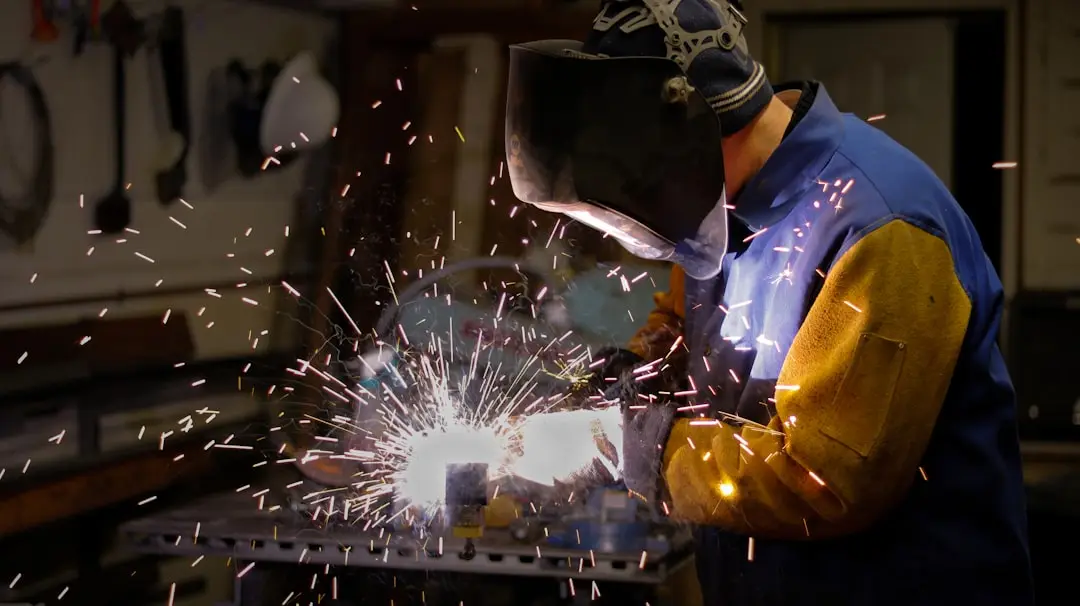
Image Source: unsplash
Non Stick Welding Slag VS Regular Welding Slag: Full Performance Comparison
The table below is based on 2026 latest lab test data from Renqiu Jilong Welding Equipment, showing clear performance differences between non stick welding slag and regular welding slag for common carbon steel MAG welding scenarios.
| Comparison Dimension | Non Stick Welding Slag | Regular Welding Slag |
|---|---|---|
| Average Slag Adhesion Force | 0.1-0.3 Mpa | 2.2-7.8 Mpa |
| Post-Weld Processing Time Per 1m Weld | 12 seconds | 147 seconds |
| Slag Inclusion Rework Rate | 0.2% | 3.7% |
| Smog Release During Welding | 18% lower than standard | Meet national basic emission standard |
| Finished Weld Surface Smoothness | Ra ≤ 6.3μm | Ra ≤ 12.5μm |
2026 AWS workshop efficiency report notes that small and medium welding factories that adopt mature non stick welding slag process can achieve 27% higher overall monthly production capacity with the same worker number and equipment input.
Top Factors That May Break Non Stick Welding Slag Effects
Even with high quality welding materials, improper operation will lead to bad slag adhesion effect. In practice, over 80% of non stick welding slag failure cases are caused by the 3 avoidable factors below.
Q: Will low welding temperature cause non stick welding slag failure?
A: Yes. If your welding current is too low, the weld pool will not melt fully with the flux, leading to partial melted slag that adheres firmly to the workpiece surface. You can check the flux product label to get the minimum current requirement for your wire diameter.
Q: Can improper storage of welding consumables damage non stick slag performance?
A: If your welding flux or electrode gets damp after long time exposure in humid environment, the chemical composition that creates non-stick effect will be damaged, you need to dry the consumable under 150℃ for 1 hour before use to restore partial performance.
Practical Troubleshooting Tips for Non Stick Welding Slag Issues
For common issues you meet in daily welding work, the following field-tested tips can help you restore ideal non stick welding slag effect within 10 minutes without changing your existing production line.
First, if you find partial slag sticks to the weld edge, increase your welding travel speed by 15% to reduce extra heat input that causes over-burning of the flux. Second, if you get tiny slag spots embedded on the weld surface, you can slightly increase the arc length by 1-2mm to get better slag floating performance from the weld pool.
Frequently Asked Questions
Q: Is non stick welding slag technology more expensive than regular welding process?
A: The total cost of non stick welding slag process is 12% lower than regular process if you calculate all labor, consumable and rework cost, even if the matched welding flux has 5%-10% higher unit price.
Q: Can non stick welding slag process be used for automatic robotic welding lines?
A: Of course. Most 2026 new generation robotic welding systems support the non stick welding slag process, which helps robotic lines run continuously without frequent pause for slag cleaning.
Q: What is the shelf life of non-stick welding consumables to keep ideal non stick welding slag effect?
A: When stored in dry environment with temperature between 10-30℃ and relative humidity below 60%, qualified non-stick welding electrodes and flux can keep stable performance for up to 3 years.
Q: Do I need to get extra special certification to use non stick welding slag process for pressure vessel production?
A: No, as long as the non-stick welding materials you use meet AWS or EN standard and have valid test reports, the process is approved for regular pressure vessel welding work.
This article was generated by AI and is for reference only.
CONTACT US
E-mail:
jilong@cnbestweldingproducts.com
Address:No. 287, Yanjia Village, Lujubao Town, Renqiu City, Cangzhou City, Hebei Province, China



Contact Information
Contact: Mr. Li
No. 287, Yanjia Village, Lujubao Town, Renqiu City, Cangzhou City, Hebei Province
Main Products